How to Make a Wig at Home with Weave: The Ultimate Step-by-Step Guide for Gorgeous, Budget-Friendly Hair

Let’s be real — wigs have had a serious glow-up lately. From celebrities rocking them on red carpets to everyday queens slaying their protective styles, wigs are absolutely everywhere. And the best part? You don’t need to spend a fortune to get something gorgeous and full-bodied. With a little patience, the right supplies, and this guide in hand, you’ll be crafting professional-looking wigs right in your own living room!
This post contains affiliate links. If you purchase through my links, I may earn a small commission at no extra cost to you. I only ever recommend products I genuinely believe in.
Whether you’re a complete beginner or someone who’s dabbled with weaves before, this tutorial has got you covered. We’re talking materials, step-by-step technique, styling tips, common mistakes to avoid, and answers to the questions everyone’s afraid to ask out loud. Ready? Let’s get into it!
Why Make Your Own Wig? (The Benefits Are Real!)
Before we dive into the how-to, let’s talk about the why. Why bother making a wig at home when you could just buy one? Oh, where do we even begin! First off, custom-made wigs fit your head like a glove — literally. Store-bought wigs can be too tight, too loose, or just… off. When you DIY, you control every measurement. You choose the texture, density, color, and length. Talk about a power move!
Secondly, making your own wig is a serious money-saver. A high-quality pre-made wig can run you anywhere from $150 to $600+. But when you source your own weave bundles and a wig cap, you can create something equally stunning for a fraction of that cost. According to Ashimary Hair, a reputable supplier known for premium bundles, DIY wigs are one of the most cost-effective ways to enjoy quality hair. Smart, right?
What You’ll Need: Gathering Your Supplies

Before you even think about picking up a needle and thread, make sure you’ve got everything on deck. Running out of supplies mid-project is the absolute worst — don’t let it happen to you!
Here’s your essential materials checklist:
- Weave bundles (2–4 bundles depending on length and desired thickness)
- A wig cap or dome cap in your skin tone or a neutral color
- Wig mannequin head or a styrofoam head
- T-pins or straight pins to secure the cap
- Curved sewing needle and weaving thread matching the hair color
- Sharp scissors — this is not the place for dull ones!
- Measuring tape
- Lace closure or frontal (optional but highly recommended for a natural hairline)
- Got2b glued spray or hair glue for finishing
- Rat tail comb and your favorite styling products
You can find most of these items easily on Amazon — search “wig making kit with weave” and have a full starter set delivered straight to your door. Also, check out Kiss Love Hair for high-quality weave bundles that hold up beautifully through the sewing process and beyond.
Pro tip: Choose bundles with the same origin — Brazilian, Peruvian, Malaysian, etc. — to ensure consistent texture throughout your wig. Mixing origins can cause your finished look to appear uneven, especially after washing.
How to Make a Wig at Home with Weave: Step-by-Step
Alright, this is the section you’ve been waiting for! Take your time with each stage — rushing is the enemy of a polished result. Good things take time, and your crown deserves nothing less than perfection.
Step 1: Measure and prep your wig cap
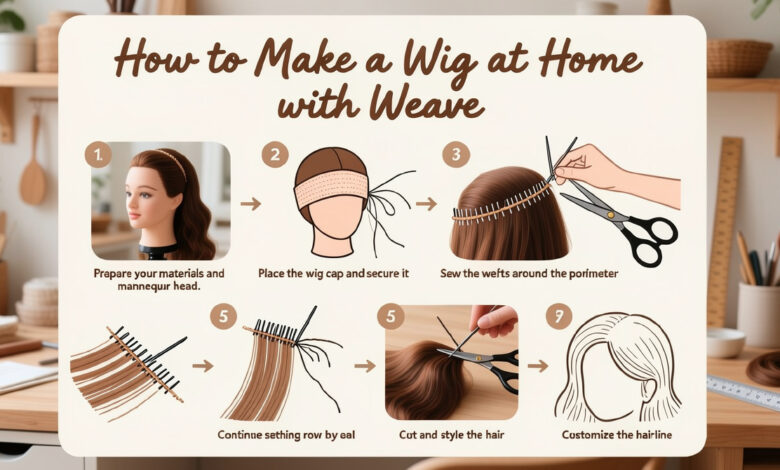
Use your measuring tape to measure your head circumference, front to nape, and ear to ear across the crown. Stretch the wig cap to match your measurements and secure it onto the mannequin head with T-pins. Then sew along the edges of the cap with a running stitch to reinforce it — this prevents the cap from stretching out of shape during construction.
Don’t skip the reinforcement step! A well-prepped cap is the foundation of a wig that actually looks good and holds its shape through regular wear.
Step 2: Prep your weave bundles
Open your bundles and keep the wefts (the sewn tracks of hair) intact. Do not cut them yet — you’ll trim each weft to size as you go, row by row. Use a tail comb to keep the hair neat and tangle-free while you work.
It helps to hang your bundles or drape them over the mannequin stand so the hair stays organized. Tangled, jumbled bundles mid-sew will slow you down and test your patience in a big way!
Step 3: Start sewing from the nape upward
Begin at the bottom edge of the wig cap, the nape area. Cut a weft to fit the width of the cap at that row and sew it on using your curved needle and thread. Use a whip stitch (also called a lock stitch) for extra security. Continue sewing rows upward, spacing them about ½ to ¾ inch apart for good, even coverage.
Make sure each weft is sewn securely on both ends before moving on to the next row. Loose ends will cause the weft to unravel inside the cap, and that’s a nightmare to fix once you’ve layered more rows on top!
Step 4: Add your closure or frontal
When you reach the top of the wig cap, sew your lace closure or frontal in place instead of adding another weft row. This creates the most natural-looking hairline and is absolutely essential if you plan to wear the wig parted or pulled back. A 4×4 or 5×5 closure works great for center or side parts; a 13×4 frontal gives you maximum styling flexibility.
Sew the closure down firmly around all edges, making sure it lies flat against the cap. Any lifting or bunching here will show once the wig is on your head, so take your time and get it right.
Step 5: Customize, style, and wear!
Remove the finished wig from the mannequin head and try it on! Check the fit and make any adjustments — tighten the wig band, trim the lace along the hairline carefully, or pluck the closure hairline to make it look more realistic. Now comes the really fun part: style your wig! Curl it, straighten it, add layers — make it completely yours.
For that sleek, laid-down finish, spritz some got2b glued spray along your edges, press the hairline down, and let it set for a few minutes. Voilà — a wig that looks like it grew right out of your scalp!
Choosing the Right Hair: Textures and Quality
Not all weave is created equal, and this is one area where you absolutely cannot cut corners (except with actual scissors). The quality of your bundles will make or break your finished wig. Look for “virgin hair” — unprocessed and never chemically treated — or “Remy hair,” where the cuticles are aligned in the same direction to minimize tangling. These types of hair look more natural and last significantly longer.
Popular textures for DIY wigs include body wave (gorgeous S-pattern waves, very natural-looking), straight (sleek and versatile), deep wave (full, lush, ultra-glamorous), kinky curly (perfect for a natural hair aesthetic), and water wave (effortless, beachy vibes all day long). The right texture is really just a matter of personal style — there’s no wrong answer here!
For top-tier bundles, Ashimary Hair is a favorite in the DIY wig community for consistent quality and true-to-length measurements. Furthermore, if you’re shopping on a budget, Amazon has a wide range of human hair bundles with thousands of reviews to help you find a reliable option.
Common Mistakes to Avoid
Oh, we’ve all been there — you spend hours sewing only to realize something went sideways (literally). Learning from other people’s mistakes is half the battle when mastering how to make a wig at home with weave. So let’s sidestep these blunders before they happen:
- Skipping measurements — always measure your head first, no guessing!
- Using too few bundles — skimping leads to a thin, wispy wig that won’t fool anyone
- Not reinforcing the wig cap — without it, the cap stretches and the wig loses its shape
- Sewing rows too far apart — this leaves visible gaps and looks unnatural
- Forgetting to seal weft ends — use a lighter or a weft sealer to prevent fraying
- Rushing the lace cut — uneven lace ruins the whole finished look
And honestly? The biggest mistake beginners make is comparing their first wig to a professional’s tenth. Give yourself some grace! Every wig you make will be better than the last.
Styling and Maintenance Tips
So you’ve made your wig — amazing! Now, how do you keep it looking fresh? First, always store your wig on a wig stand when you’re not wearing it. Storing it balled up in a drawer is a one-way ticket to tangle city.
When washing, use a sulfate-free shampoo and a moisturizing conditioner. Wash in a downward motion — never circular, as that causes tangling — rinse with cool water, and allow it to air dry on the stand. Avoid excessive heat styling, and when you do use heat tools, always apply a heat protectant first. With proper care, a quality human hair wig made from good bundles can last anywhere from one to three-plus years. That’s serious value for money, especially when you factor in the savings from going DIY!
Frequently Asked Questions
How many bundles do I need to make a wig at home with weave? It depends on the length. For short wigs (10″–14″), 2 bundles plus a closure is usually enough. Medium-length wigs (16″–20″) typically need 3 bundles, while long wigs (22″+) often require 3–4 for full, lush coverage. When in doubt, grab an extra bundle — you can always use leftover hair for repairs or touch-ups.
Can I use synthetic hair instead of human hair? Absolutely! Synthetic bundles are more affordable and come in a huge variety of colors. However, they can’t be heat-styled and have a shorter lifespan. If you’re just practicing the technique for the first time, synthetic is a perfectly fine starting point. For a more realistic, long-lasting result, human hair is the gold standard.
How long does the whole process take? For beginners, expect to spend 3 to 6 hours on your first wig. As you build speed and confidence, you can finish a wig in 1.5 to 2 hours. Put on your favorite playlist and get comfortable — it goes faster than you’d think!
Do I need a sewing machine? Nope! Hand-sewing with a curved needle and weaving thread is the traditional method and gives you great control, especially as a beginner. Many professional wig makers still prefer hand-sewing. A machine can speed things up eventually, but it’s definitely not required to get started.
What is the best stitch for sewing wefts onto a wig cap? The whip stitch (lock stitch) is the most popular and reliable choice. It creates a tight, secure seam that won’t easily come undone. Some wig makers also add a running stitch along the cap edges for extra reinforcement.
The Bottom Line: Your Wig Era Starts Now
Well, there you have it — everything you need to know, neatly wrapped up! Making your own wigs is genuinely one of the most empowering beauty skills you can learn. You save money, get a perfect custom fit, and end up with something completely unique to you. That’s not just a wig — that’s a statement.
So what are you waiting for? Grab your bundles from Ashimary Hair or Kiss Love Hair, pick up a wig-making kit on Amazon, and get started this weekend. Your future self — the one with flawless, custom-made hair on rotation — is going to thank you big time. Now go slay, queen. You’ve absolutely got this!